For about 20 years, Ray Keating wrote a weekly column - a short time with the New York City Tribune, more than 11 years with Newsday, another seven years with Long Island Business News, plus another year-and-a-half with RealClearMarkets.com. As an economist, Keating also pens an assortment of analyses each week. With the Keating Files, he decided to expand his efforts with regular commentary touching on a broad range of issues, written by himself and an assortment of talented contributors and columnists. So, here goes...
Showing posts with label entrepreneurship. Show all posts

Wednesday, April 20, 2022

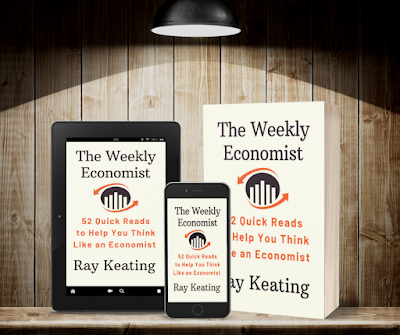
NEW BOOK: “The Weekly Economist” Helps Readers to Think More Like an Economist

 Ray Keating’s New Book Offers Quick Reads on Wide-Ranging Topics and Questions Related to the Economy and Business


If you don’t have a degree in economics, how do you figure out what actually makes economic sense and what doesn’t? Ray Keating, a leading economist on small business and entrepreneurship, offers help with a new book titled The Weekly Economist: 52 Quick Reads to Help You Think Like an Economist.


Whether via CNBC, CNN, FOX, websites, or other outlets, many assertions regarding the economy and economic policy are presented that leave people wondering what’s accurate and what’s not. That’s especially the case when declarations by one talking head are conflicted by the next one. The Weekly Economist offers quick reads on topics essential to thinking clearly on economics, or applying sound economic principles to hot topics.


Ray Keating notes, “Yes, economics and thinking more like an economist matter. It is my hope that individuals, by taking just a few minutes for a quick read each week, can clarify their thinking on economics, and thereby, improve their own lives, and the lives of family, friends, colleagues, neighbors, as well as people across the nation and around the world."


Beyond a general readership interested in the economy, The Weekly Economist is ideal for the classroom, boardroom and workplace.


The Weekly Economist complements Ray Keating’s Free Trade Rocks: 10 Points on International Trade Everyone Should Know, which is an excellent economics introduction to the often controversial topic of free trade.


Paperbacks, hardcovers and the Kindle edition of The Weekly Economist are available at Amazon.com, and signed books at www.RayKeatingOnline.com. 


Review copies, and author interviews and appearances are available upon request. 


Praise for Ray Keating’s work…


“Keating is at his best when tackling the issue that introduced him to the world of conservative thought: the benefits of the free market.”  - Kirkus Reviews


“Keating is no sour-puss conservative... Keating’s pro-growth agenda of dramatic supply-side tax and regulatory cuts, school choice, and much smaller government stands as New York’s only chance at rebirth.”  - Steve Forbes


Ray Keating's "take on the economy is unabashedly supply-side, offering a clear understanding that risk taking and entrepreneurship are the engines of economic growth.” - Jack Kemp


“Keating manages to bring this seemingly dull subject to accessible life with real-world examples often torn straight from recent headlines, along with a comprehensive and (mostly) impartial view on the topic.” – Self-Publishing Review on Free Trade Rocks!


“A common-sense explanation of why politicians and bureaucrats shouldn't throw sand in the gears of global trade.” - Dan Mitchell, Chairman, Center for Freedom and Prosperity, on Free Trade Rocks!

Thursday, June 24, 2021

Free Enterprise in Three Minutes with Ray Keating – Episode #109: Entrepreneurship is the Right Answer to Worries over “Big Business”


For those worried about big business, while pointing out that such concerns are unwarranted, Ray makes clear that providing a policy environment in which entrepreneurship can flourish is the response that makes the most economic sense. Tune in now! 

Wednesday, June 23, 2021

Friday, January 1, 2021

Small Business Woes and Hope

 by Ray Keating

The Keating Files – January 1, 2021


The toll of COVID-19 has been horrible, including a staggering number of deaths. Of course, the economy also has been devastated, and it’s been especially hard on small businesses. I was part of this CNBC story on small business, highlighting some entrepreneurial hope for the future.


__________


Ray Keating is a columnist, novelist, economist, podcaster and entrepreneur.  His new book Vatican Shadows: A Pastor Stephen Grant Novel is the 13th thriller/mystery in the Pastor Stephen Grant series. Get the paperback or Kindle edition at Amazon, or signed books at www.raykeatingonline.com. 


The views expressed here are his own – after all, no one else should be held responsible for this stuff, right?


You also can order his book Behind Enemy Lines: Conservative Communiques from Left-Wing New York  from Amazon or signed books  at RayKeatingOnline.com. His other recent nonfiction book is Free Trade Rocks! 10 Points on International Trade Everyone Should Know.


One of the best ways to enjoy Ray Keating’s Pastor Stephen Grant thrillers and mysteries is to join the Pastor Stephen Grant Fellowship! For the BEST VALUE, consider the Book of the Month Club. Check it all out at https://www.patreon.com/pastorstephengrantfellowship


Also, tune in to Ray Keating’s podcasts – the PRESS CLUB C Podcast  and the Free Enterprise in Three Minutes Podcast  


Check out Ray Keating’s Disney news and entertainment site at  www.DisneyBizJournal.com.

Friday, May 15, 2020

The COVID-19 Crisis: Our Crushed Economy

Part I of a Projected Three-Part Series
by Ray Keating
The Keating Files – May 15, 2020

Make no mistake, the coronavirus pandemic and resulting government shutdowns of large parts of economy have had devastating effects across our economy, and the impact will not be quickly reversed. In fact, with misguided policymaking after COVID-19 has come under control (hopefully via vaccines and/or therapeutics), our economic ills could be further extended.

It pays to keep in mind that whenever the economy goes seriously off the rails, some kind of government action usually can be identified that either caused the mess or made it worse. In our current situation, the rapid spread of this virus, the threat to the lives of individuals, and the actual resulting deaths had their own negative consequences for the economy, and then governmental efforts – largely necessary though far from perfect (anyone who expects something even close to efficiency from government in anything doesn’t understand government) – have resulted in harsh economic consequences.


This column is not meant as an argument against what the government has done, nor as some kind of support for all that government has implemented. It’s also not meant to align with those arguing irresponsibly for an immediate, mask-less reopening of the economy with little concern, it seems, for ongoing efforts against spreading this virus. What follows is a look at key indicators describing our grim state of economic affairs.

First, real GDP (i.e., inflation-adjusted gross domestic product) in the first quarter plunged by 4.8 percent, with all major categories of economic activity declining dramatically, including consumer spending, business investment and trade. During the post-World-War-II era, there were only seven quarters when the economy declined by larger percentages.

Second, information coming in about the start of the second quarter points to an even larger drop in GDP. For example, retail sales plunged by 16.4 percent in April. That was the biggest monthly decline in a dataset going back to 1992. Industrial production – that is, the real output of the manufacturing, mining, and electric and gas utilities – tumbled by 11.2 percent in April. That was the largest monthly decline on record in an index that dates back 101 years. The drop in manufacturing production was even larger at 13.7 percent – again, biggest decline on record.

Third, jobs are disappearing at a frightening pace. Initial weekly unemployment claims over the first eight weeks of the COVID-19 crisis tallied up to 36.5 million. The story from the April employment report arguably was even worse. Perhaps most distressing was the fact that the employment-population ratio in April fell to the lowest level ever recorded in a dataset going back to 1948, plummeting from 61.1 percent in February to 60 percent in March, and then to 51.3 percent in April. 

Fourth, entrepreneurship is suffering as well. For example, the number of unincorporated self-employed individuals – an important measure of small business and startup activity – declined in April to its lowest level since January 1980. 

For good measure, the Census Bureau recently reported that business applications for tax IDs – one measure of business formation (though far from complete) – took a dive of 4.5 percent in the first quarter of this year. In addition, high-propensity business applications – which are businesses with a high likelihood to turn into businesses with payrolls – fell by 5.4 percent in April. These measures of entrepreneurial activity promise to fall further in the second quarter of this year.

Indeed, there’s nothing positive going on in the U.S. economy currently. We’re likely to see the steepest decline in economic activity during the second quarter of this year (that is, the current quarter) since the Great Depression.

After reviewing these grim numbers and trends, it’s critical to understand that these aren’t just some cold statistics detached from reality. Instead, they quantify reality. These numbers reflect or communicate real economic hardship for tens of millions of Americans across the nation. At the same time, these numbers do not negate the realities of mounting coronavirus deaths, and the understanding that the number of deaths could have been much worse, and still threaten to get worse. More on that in Part II in this series.

__________

Ray Keating is a columnist, economist, podcaster and entrepreneur.  You can order his new book Behind Enemy Lines: Conservative Communiques from Left-Wing New York  from Amazon or signed books at RayKeatingOnline.com. His other recent nonfiction book is Free Trade Rocks! 10 Points on International Trade Everyone Should Know. Keating also is a novelist. His latest novels are  The Traitor: A Pastor Stephen Grant Novel, which is the 12th book in the series, and the second edition of Root of All Evil? A Pastor Stephen Grant Novel with a new Author Introduction. The views expressed here are his own – after all, no one else should be held responsible for this stuff, right?

Also, tune in to Ray Keating’s podcasts – the PRESS CLUB C Podcastand the Free Enterprise in Three Minutes Podcast 

Friday, March 13, 2020

11 Point Guide to Working at Home

by Ray Keating
The Keating Files – March 13, 2020

With so many businesses having employees working from home due to the coronavirus, my response is: “Welcome!” I’ve had a home office for just about 29 years. It’s kind of sobering to ponder, but the work-at-home gig began for me way back in 1991.


With this long track record, here’s a quick 11-point guide to working from home based on my experiences.

1. You Better Love Your Job. If you don’t enjoy, are indifferent, or positively dislike your job, then working from home might not go so well. Working in your house or apartment means that all kinds of interesting distractions lurk, from binging Netflix, getting lost online, playing with the dog, or suddenly being interested in chores around the house – from cleaning the gutters to fixing the bathroom toilet. If you don’t like your work, those distractions can become quite tempting.

2. Carve Out a Workspace. Working from home and Wi-Fi allows for getting stuff done on your laptop probably anywhere in your home – and I certainly do that. However, the most productive time usually is found in an actual home office. Since the coronavirus has people working at home who normally don’t, you might not have the space for an actual office. But other spots around the house can work in a pinch, such as a dining room or kitchen table, or even a bedroom. But if working at home is going to be for a long haul, space away from the traffic of daily life is a big plus.

3. Boost Productivity by Focusing on Objectives, Goals and Completing Projects, Not the Clock. Working from home shouldn’t mean doing the 9-to-5 thing. Instead, the home office – away from the traditional workplace setting – allows for focusing on accomplishing objectives or goals, such as completing projects, and then perhaps taking a break – even a quick jaunt to the park or beach – before moving on to the next item on the to-do list. It’s about meeting deadlines, not about the exact time spent at the desk.

4. Eliminating Meaningless Meetings. Productivity also gets a boost thanks to, for the most part, eliminating the plague of meaningless, wasteful meetings. Meetings generally suck up time and grind work to a near halt. (Can you tell I hate meetings?) Working at home means few, if any, meetings, and that’s productivity heaven.

5. Discipline and Deadlines Rock. My time as a weekly newspaper columnist taught me the many benefits of being disciplined, in particular, via deadlines. Lots of people (most?) don’t like deadlines, but when embraced, deadlines not only require discipline with time and effort (that is, less waste), but actually benefit creativity. Too often, when working independently, delay can become the default setting, and nothing gets done. Nothing getting done means, by definition, no creativity. Deadlines mean that projects must get done, and this winds up serving as an impetus to creativity.

6. Independence Required. Whether faced by something like the coronavirus or being considered for other reasons, working from home requires the ability to work independently. If that’s not you, then you need to learn quickly or suffer accordingly.

7. Enjoy the Flexibility. While the 9-to-5 workplace can be rather regimented, one of the great benefits of having a home office is flexibility. This goes back to the aforementioned focusing on getting projects done and goals met, rather than being a slave to the clock. A project focus means far greater workday flexibility, and that is one of the great benefits of working at home. Indeed, enjoy the flexibility.

8. From Commuting to What? Working at home eliminates the commute. I went from commuting to lower Manhattan – almost two hours each way every day – to no commute at all. It pays to think about how to use that time gained in ways that improve your life. The key is to make it a conscious decision; otherwise, opportunities – whether on the career front or in family life, for example – can be lost.

9. Don’t Let Work Take Over. As I noted earlier, enjoying your work is crucial when working at home. However, it then can be easy to let your work takeover or crowd out other aspects of your life. This is a work-at-home risk that you need to guard against.

10. Great Tunes. Working at home allows for working in a manner that can improve your outlook and productivity, but also in a way that perhaps wouldn’t cut it in a more traditional workplace. For me, it’s music. Music has a powerful effect on my mood and outlook, so I have assorted playlists at the ready to get me in the right frame of mind to, in my case, write. And yes, I play it loud.

11. Start a Business? Finally, use time working at home due to the coronavirus to explore opportunities. Namely, use this as a test run to see if becoming an entrepreneur is for you. If the working independently and creatively thing holds great appeal, then explore starting up a business. That doesn’t mean that you have to quit the fulltime gig – indeed, most of us cannot afford to do so – but your own business can be fulfilling in many ways, can supplement the family income, and can eventually become what you do fulltime. If you’ve ever thought about being an entrepreneur, then a stint of working from home can help you decide.

__________

Ray Keating is a columnist, an economist, a novelist (his latest novels are The Traitor: A Pastor Stephen Grant Novel, which is the 12thbook in the series, and the second edition of Root of All Evil? A Pastor Stephen Grant Novel with a new Author Introduction), a nonfiction author (among his recent works is Free Trade Rocks! 10 Points on International Trade Everyone Should Know), a podcaster, and an entrepreneur. You can also order his forthcoming book Behind Enemy Lines: Conservative Communiques from Left-Wing New York– signed books or for the Kindle. The views expressed here are his own.

Tuesday, March 10, 2020

A Coronavirus Recession Likely

by Ray Keating
The Keating Files – March 10, 2020

Whether the coronavirus meets the worst or best of expectations in the United States, it’s difficult to see how a recession is missed – or at best, narrowly avoided with growth slowing to a crawl.


Consider that despite the happy talk – or tweets – emerging from assorted political sources, the U.S. economy has not been rocking and rolling. In fact, after some respectable growth numbers from mid-2017 through the third quarter of 2018, the economy has slowed notably since, with real GDP growth averaging only 2.1 percent over the past five quarters.

For good measure, real business investment (as well as overall private investment) has declined in the past three quarters (i.e., the second quarter through the fourth quarter of 2019), and trade has been drag on the economy for the past two years.

Finally, much of economic growth over the past two-plus years has been about the consumer. However, the consumer is a follower, not a leader. Consumers take their cues from what’s going on with business. That is, if new enterprises are being started, and businesses are investing and hiring, then consumers are pleased and spending. While entrepreneurship has been lagging, businesses have been hiring. But given the recent decline in business investment and the uncertainties of the coronavirus, business investment is likely to continue to falter, in the near term, and along with it, now, hiring.

To sum up, when you look at the current status and coming months, there’s little positive to see for major sections of the U.S. economy. Private investment is likely to continue to falter (or at best stagnate), trade will continue to be a drag, and the consumer is likely to be hunkering down. That combines to spell either a recession or no growth in the short term.

Another question to ponder: Is the U.S. well-positioned from a policy standpoint so that economic growth snaps back afterwards – either later this year or into 2021? Consider that we were not positioned to do so after the last recession, and have since suffered through an under-performing recovery/expansion period since mid-2009. Quick answer? Trade policy remains anti-growth, as does government spending (with big spending increases over the last two years). Taxes generally have been a policy positive since December 2017. The regulatory story has been mixed, but overall a net plus. And monetary policy remains unhinged from economic reality, with the hope being that Fed cluelessness continues to be corrected or ignored by the private sector.

Oh yes, and then there’s this presidential and congressional election thing coming in November?

Snap back or no, then? It’s hard to tell. My best guess is that a short recession or no-growth period is followed by a short snap back, and then barring some strong pro-growth policy changes, the economy falls back into the slow-growth scenario that we’ve suffered under for too long.

__________

Ray Keating is a columnist, an economist, a novelist (his latest novels are The Traitor: A Pastor Stephen Grant Novel, which is the 12thbook in the series, and the second edition of Root of All Evil? A Pastor Stephen Grant Novel with a new Author Introduction), a nonfiction author (among his recent works is Free Trade Rocks! 10 Points on International Trade Everyone Should Know), a podcaster, and an entrepreneur. The views expressed here are his own.

Sunday, April 29, 2018

Free Enterprise in Three Minutes, Episode #10: Profits Aren't Evil

No matter what you might have heard about profits being “evil,” Ray Keating makes clear that is not really the case. Instead, Keating explains the critical roles that both profits and losses play in our economy.

List at http://www.buzzsprout.com/155969/692182-episode-10-profits-aren-t-evil


Sunday, March 18, 2018

Thursday, March 31, 2016

Throwback Thursday: Creators, Conspirators and Monopolists, Oh My!

by Ray Keating

Prominent businessmen don’t always understand how the economy actually works. That’s been evident on the presidential campaign trail this year, with Donald Trump leading the Republican field and Michael Bloomberg’s brief flirtation with jumping into the race as an independent. Trump and Bloomberg clearly are clueless on a host of issues – such as Trump on trade – regarding how the economy functions and how policy impacts the economy. But, of course, there are many business leaders who understand how the economy works, and even offer some rather unique insights. That’s the case with Peter Thiel and his book “Zero to One: Notes on Startups, or How to Build the Future.” The following review ran as a Long Island Business News column of mine in October 2014 …

I recently headed west to Silicon Valley for a gathering focused on technology policies. At the start of that journey, standing in an airport bookstore, I decided to get the full Silicon Valley techie experience, and picked up Peter Thiel’s new book “Zero to One: Notes on Startups, or How to Build the Future.”

It’s a valuable, quick read that provides fascinating insights on thinking about entrepreneurship and the economy, and what’s needed to start up a business.

Thiel was a co-founder of PayPal, and has been an investor in a variety of startups, including Facebook. His perspectives on how businesses function in the economy are drenched in a refreshing economic reality.

The central theme of Thiel’s message is the need to create new things. He points out, “Doing what we already know how to do takes the world from 1 to n, adding more of something familiar. But every time we create something new, we go from 0 to 1.” He warns, “Unless they invest in the difficult task of creating new things, American companies will fail in the future no matter how big their profits remain today.”

One would expect Thiel to declare that the word for “0 to 1 progress is technology.” However, he quickly adds that it’s not all about computers: “Properly understood, any new and better way of doing things is technology.” Another word for that is innovation.

For Thiel, building the future and creating new things is accomplished by monopolies. What? How can that be? Well, he has a better grasp on how the economy actually works than many economists. Thiel correctly rejects the concept of “perfect competition” that is taught in all Economics 101 classes, whereby undifferentiated firms and homogeneous products sell at the market price, and economic profits are competed away. That’s not how the economy works, nor quite frankly, does it help students to understand the market process.

But what about this monopoly thing? Thiel writes: “To an economist, every monopoly looks the same, whether it deviously eliminates its rivals, secures a license from the state, or innovates its way to the top. In this book, we’re not interested in illegal bullies or government favorites; by ‘monopoly,’ we mean the kind of company that’s so good at what it does that no other firm can offer a close substitute.”

While he does not put it exactly this way, what entrepreneurs and businesses are doing within a competitive environment is investing and innovating to create what effectively are temporary monopolies that allow profits to be maximized. And the longer a firm excels at providing something that consumers cannot get elsewhere, the longer the business can maintain that temporary monopoly. That’s quite different from the government-protected or created monopoly, for example, that grows fat, lazy and rips off consumers.

As Thiel proclaims, “Creative monopolists give customers more choices by adding entirely new categories of abundance to the world.”

Thiel’s subsequent advise and ideas for those looking to start up new businesses spring from this basic understanding of what entrepreneurs and businesses need to do – that is, to create something new and better – if they seek bold success. And he offers many valuable insights on that process. But among my favorite bits of wisdom tie in to how to think about business and career – one has to do with chance and the other secrets.

On business success being all about chance, Thiel counters that if that were the case, we would not see the successful serial entrepreneurs that we obviously do. He adds: “Learning about startups is worthless if you’re just reading stories about people who won the lottery.”

And on creative secrets, he provocatively but accurately writes, “The best entrepreneurs know this: every great business is built around a secret that’s hidden from the outside. A great company is a conspiracy to change the world; when you share your secret, the recipient becomes a fellow conspirator.”

So, here’s to those creative, conspiratorial monopolists who change the world.

______________

Mr. Keating is an economist and novelist who writes on a wide range of topics. His Pastor Stephen Grant novels have received considerable acclaim, including The River: A Pastor Stephen Grant Novel being a finalist for KFUO radio’s Book of the Year 2014, and Murderer’s Row: A Pastor Stephen Grant Novel winning Book of the Year 2015.

The Pastor Stephen Grant Novels are available at Amazon…


Thursday, February 4, 2016

Throwback Thursday: Following the Entrepreneurial Dream to Walt Disney World, and Beyond

by Ray Keating

I work with entrepreneurs, teach about entrepreneurship, and am an entrepreneur. So, I enjoy interviewing interesting entrepreneurs. One entrepreneur I interviewed not too long ago was Lou Mongello. The interview turned into a two-part series for my old Long Island Business News column (running in late summer 2014). I enjoyed the interview and writing about it, as Lou is the definition of the optimistic, enthusiastic entrepreneur. Here are the articles…


First in a Two-Part Series on Following Entrepreneurial Dream

It’s not unusual to hear about people moving from the northeast – particularly from New York and New Jersey – to Florida. In fact, it’s been a river of humanity heading south for some time, especially when it comes to retirees.

It’s also pretty common to come across people with dreams of turning passions into businesses, but they fail to take the entrepreneurial plunge.

Then there are those who take their shots at entrepreneurial success. Consider a guy from New Jersey with a family, a home and a solid career. He quits his job, sells the house, and heads to Florida to follow his entrepreneurial dreams built on a lifetime love of Walt Disney World?

That’s what Lou Mongello did. For those dreaming of transforming a passion into an entrepreneurial reality, Mongello is a role model.

As he said in an interview, “I get to talk about Walt Disney World for a living.” Since 2005, he has done an audio podcast on his WDWRadio.com website, along with videos, blog posts, live events and broadcasts, and assorted special events… Mongello’s latest book is 102 Ways to Save Money For and At Walt Disney World, and he has written two Walt Disney World trivia books, and is working on a third.

Bottom line: If you want to know anything about Walt Disney World, or Disney in general, Lou Mongello is the man. How he became that man is a fascinating and inspirational story for current and aspiring entrepreneurs.

His passion for Disney goes back to childhood days, with his family going to Disney World every year – “at least once a year” – since November 1971. Mongello said, “My parents were Disney fans, and made us Disney fans. I became fascinated… I learned everything I could about this place that I was so very much in love with.”

When he eventually told his wife that he wanted to write a book, her response was: “Well, all you know about is Disney World.” Mongello reported, “I went downstairs and started writing, and haven’t come out of the basement since.”

As he tells it, he was doing well as a lawyer in New Jersey, with an IT consulting business on the side. But a book on Disney World led to the website to articles to podcasts. It “snowballed.” He was flying back and forth to Florida, and then the realization hit: “I think I can make a business out of this hobby. I sold the house I thought I was going to own forever. I brought money to my closing, which, as you know, is not the way it’s supposed to work. And I packed up the Honda Odyssey, and I moved to Florida.”

He went full-time talking and covering Disney in 2007. He called it “a very big, very scary leap of faith.” Unlike those who talk about following their entrepreneurial dreams but never really pull the trigger, Mongello decided “to go all in.”

What’s Mongello’s advice when looking to start up a business? He states in straightforward fashion, “You need to find out what your passion is .., define your goals,” and “start taking action however small.”

He also warned: “Prepare yourself and the people around you for the sacrifices that you need to make. There are going to be sacrifices. For most people, it doesn’t happen overnight.” Mongello noted “an incredible support system” in his own journey, including “my wife and my parents.” It’s that support system that gets “you through tough times with business,” adding that’s “one of the most important aspects that people really need to keep in mind.”

Next week’s column will touch on some of Mongello’s insights regarding brands, customers, social media and podcasts. For now, let’s close with a Lou Mongello inspirational note for entrepreneurial dreamers: “You can do what you love and do it full time.” He certainly has.


Second in a Two-Part Series on Following Entrepreneurial Dream

How do you turn a passion into a business? That’s a question I often work through with the MBA students that I teach at Dowling College.

The best lessons, as those students will tell you, often come from the real-world experiences of entrepreneurs, rather than from a textbook.

Lou Mongello is just such an entrepreneur. As explained in last week’s column, Mongello gave up being a lawyer in New Jersey and moved to Florida to become one of the foremost experts on Walt Disney World, and all things Disney. He does podcasts, videos, live broadcasts, hosts events, and writes books on Disney World. Consider that Podcast Awards voted his WDWRadio.com podcasts the best travel podcast for every year from 2006 through 2013.

Mongello’s entrepreneurial ventures also include speaking to businesses, schools and conferences on ways of achieving business dreams, and advising podcasters on how to make their ventures profitable.

When I asked Mongello about what he had learned from the Disney company for his own enterprise, he spoke about one’s brand: “You hear the name Disney and there is a level of expectation in that brand that I think is so much higher than anyone else, which is why I think the Disney brand has such incredible brand loyalty.” He noted that “you have an expectation visiting” Walt Disney World, and “99.9% of time it is going to be magical.” (Yes, he used the word “magical.”) For his own business, he explained, “Everything that I put out had to rise to that same level. Because it was associated with the Disney brand, but more importantly because my name was on it.”

And what about his customers, that is, his listeners? Mongello said, “I hate the word fans. I believe, and the way I treat the people that listen, is they’re not fans, they’re my friends because that’s how they look at me. They hear your voice every week. They watch you. They trust you. They know you better than I know them.” This perspective on customers has allowed Mongello to build an “incredible community.” He boils it down: “Treat them as friends, they become incredibly loyal. They also become the most passionate evangelists. They are the marketing team for me.”

That’s very much the case in the online, social media universe. Technology has allowed businesses to reach people in powerful ways. At the same time, consumers have heightened expectations when it comes to social media interaction. Treat customers as friends, and that’s very good business.

For Mongello, “All my social media stuff, all of my email get answered by me. I will not hand it off to somebody else because if you are going to write to me or tweet to me, you better believe that I will give the courtesy of a personal response.” He added that many big brands are catching on and “humanizing that experience.”

But what about his bread and butter – the podcast? Mongello predicts big things, and it’s hard to argue against his reasoning. He said, “I think the next 12 to 18 months there is going to be this incredible explosion of podcasting and this business of on-demand delivery of content… The podcasting medium is so incredibly personal. I’m inside your ears. You may be driving, you may be on the treadmill, but you’re focused on one thing… It is an incredibly intimate thing. There is incredible power there. There is incredible opportunity. So, businesses need to realize that they need to start getting on this platform.” Again, he points to popular podcasts on iTunes, highlighting that some larger firms are getting it on podcasts.

Finally, on a more general level regarding entrepreneurship, Mongello’s optimism cannot be restrained. He said, “I really am focused on helping other entrepreneurs. As a ‘solepreneur,’ I get how tough it is to be in a room by yourself struggling with an idea.” Then he adds, “There’s room for us all to succeed.”


______________

Mr. Keating is an economist and novelist who writes on a wide range of topics. His Pastor Stephen Grant novels have received considerable acclaim, including The River: A Pastor Stephen Grant Novel being a finalist for KFUO radio’s Book of the Year 2014, and Murderer’s Row: A Pastor Stephen Grant Novel nominated for Book of the Year 2015.

The Pastor Stephen Grant Novels are available at Amazon…